



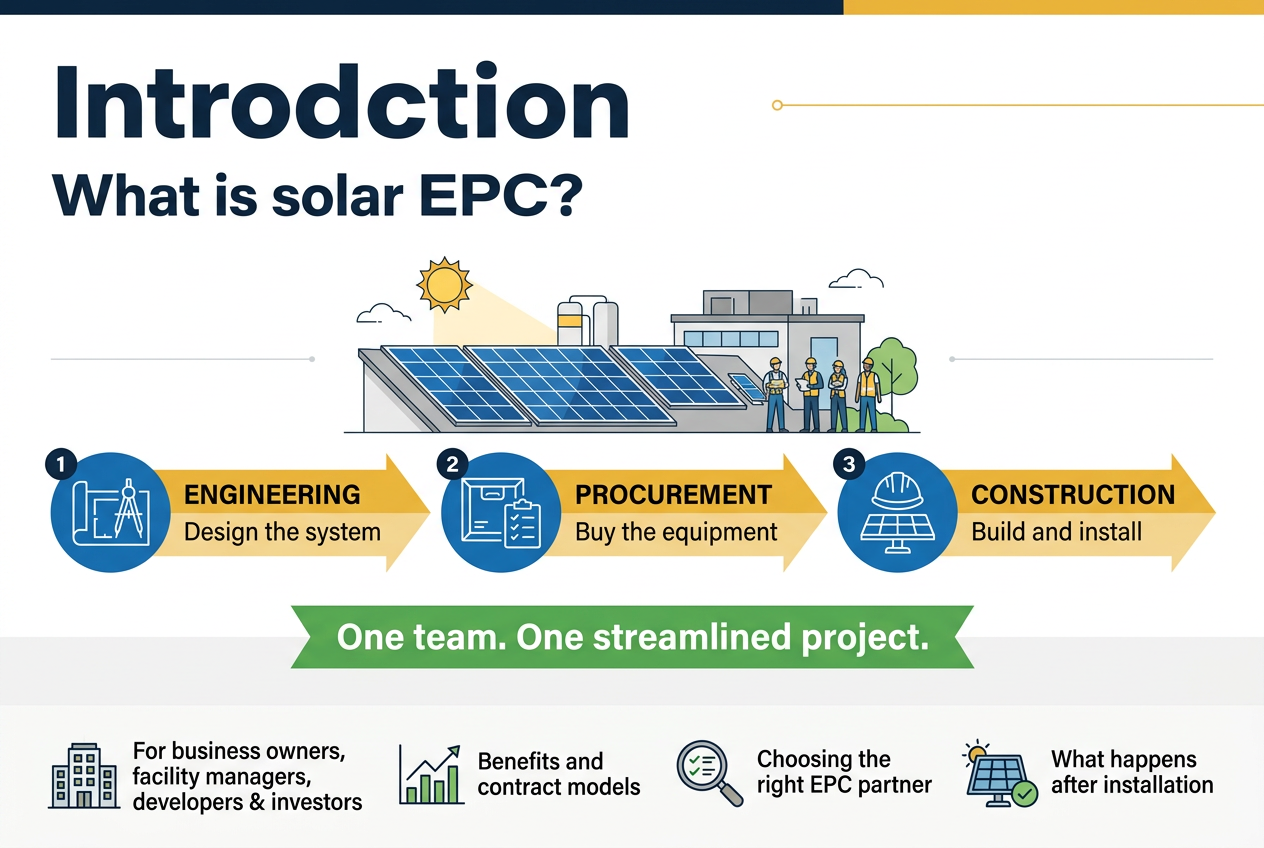
Planning a solar project and keep seeing the term solar EPC? Here’s the short version: EPC stands for engineering, procurement, and construction. One team designs your system, buys the equipment, and builds it, so you don’t have to juggle a dozen vendors.
This guide is for business owners, facility managers, developers, and investors who want to go solar without the headaches. If you’re asking what is solar EPC, you’re in the right place.
We’ll cover:
-
How the three phases work: what a solar EPC contractor does at each step, from design to installation.
-
Why it pays off: the main solar EPC benefits, plus the solar EPC contract models you’ll run into.
-
How to pick the right partner: what to check before you hire a solar EPC company, and what happens after the panels go up.
Let’s get into it.
Understanding Solar EPC and Why It Simplifies Your Project
Defining Solar EPC in Plain Terms
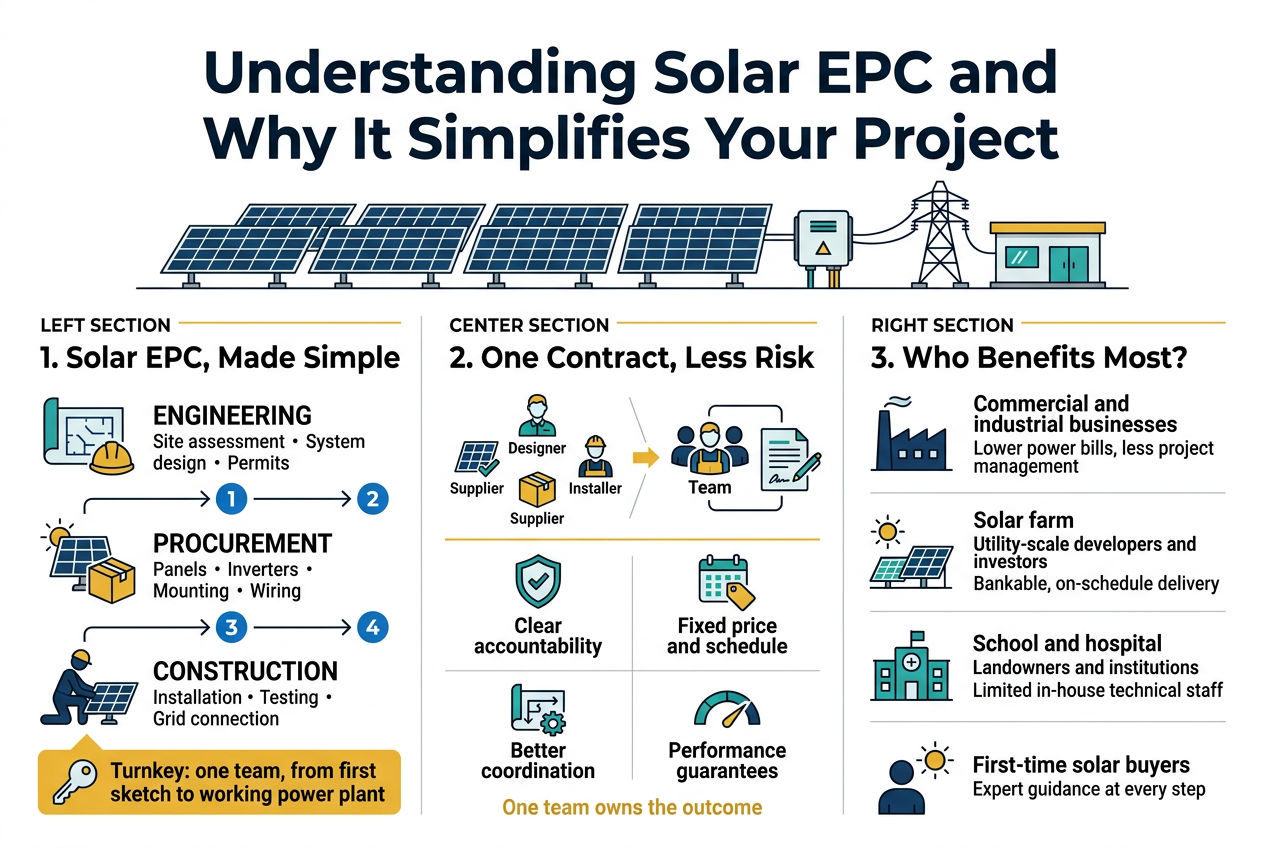
Solar EPC stands for engineering, procurement and construction. A solar EPC contractor handles all three jobs under one roof, from the first design sketch to flipping the switch.
-
Engineering: site assessment, system design, permits
-
Procurement: panels, inverters, mounting, wiring
-
Construction: installation, testing, grid connection
You’ll often hear this called turnkey solar EPC services. You hand over the keys to the project, and you get back a working power plant.
How the Single-Contract Model Reduces Risk
Without an EPC company, you’d hire a designer, a supplier, and an installer separately. When something goes wrong, everyone points at someone else.
With one contract, one team owns the outcome:
-
Clear accountability: one party answers for delays, defects, and performance
-
Fixed price and schedule: fewer budget surprises
-
Better coordination: designers and installers work from the same plan
-
Performance guarantees: the system has to hit agreed output targets
Who Benefits Most from Solar EPC Services
-
Commercial and industrial businesses that want lower power bills without running a construction project
-
Utility-scale developers and investors who need bankable, on-schedule delivery
-
Landowners and institutions like schools and hospitals with limited in-house technical staff
-
First-time solar buyers who want expert guidance at every step
Engineering: Designing a System Built for Maximum Output
Site Assessment and Energy Yield Analysis
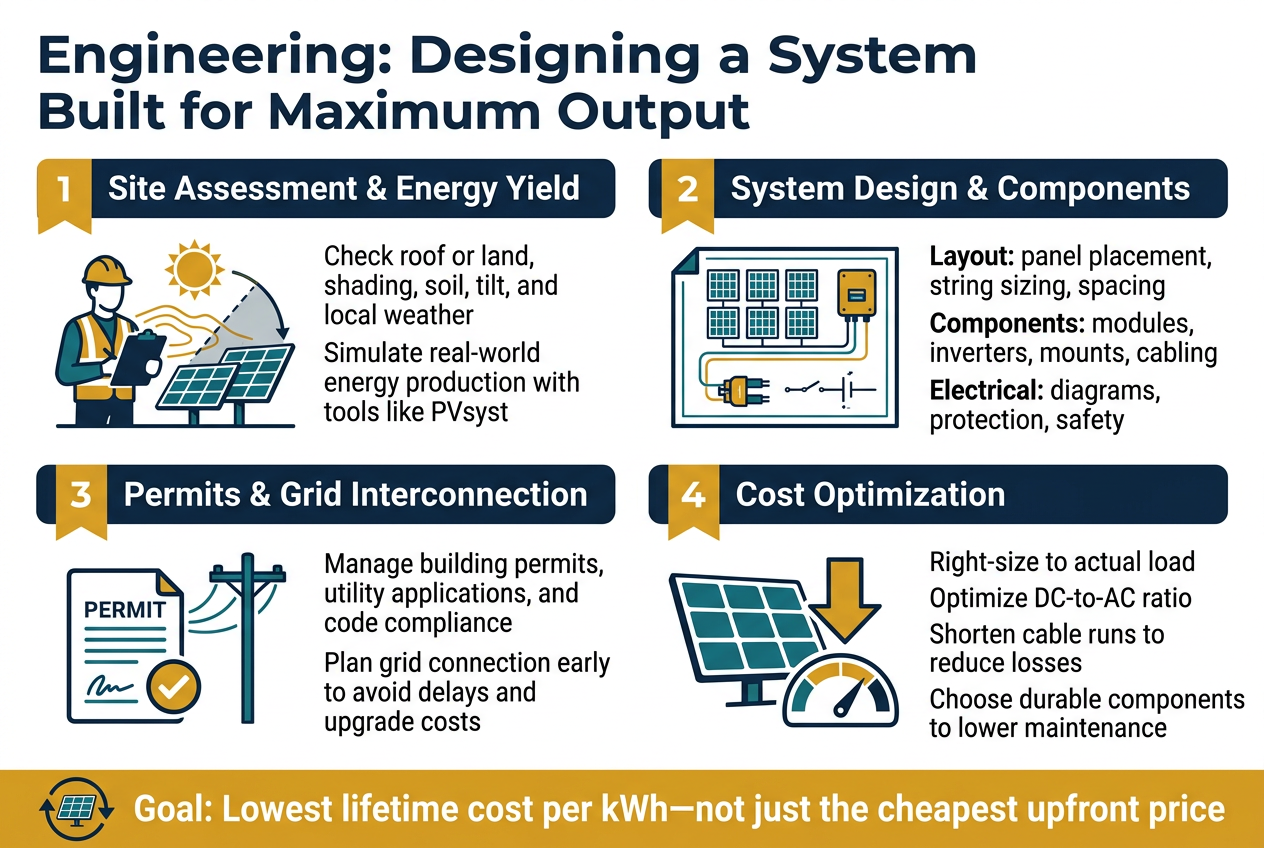
Every good solar EPC contractor starts on the ground. Engineers check roof or land condition, shading, soil, tilt options, and local weather. Then they run simulations (tools like PVsyst are common) to predict how much power the system will actually produce, not just what the brochure says.
System Design and Component Selection
This is where the blueprint takes shape:
-
Layout: Panel placement, string sizing, and spacing to cut shading losses
-
Components: Modules, inverters, mounting structures, and cabling matched to your site and budget
-
Electrical design: Single-line diagrams, protection systems, and safety features
Permitting, Compliance and Grid Interconnection Planning
Paperwork can stall a project fast. Your EPC team handles building permits, utility applications, and code compliance, and plans the grid connection early so you avoid surprise delays or upgrade costs.
Cost Optimization Through Smart Design
Smart engineering saves money without cutting corners:
-
Right-sizing the system to your actual load
-
Optimizing DC-to-AC ratios
-
Shortening cable runs to reduce losses
-
Choosing durable components that lower long-term maintenance costs
The goal is the lowest cost per kilowatt-hour over the system’s life, not just the cheapest upfront price.
Procurement: Securing Quality Equipment at the Best Value
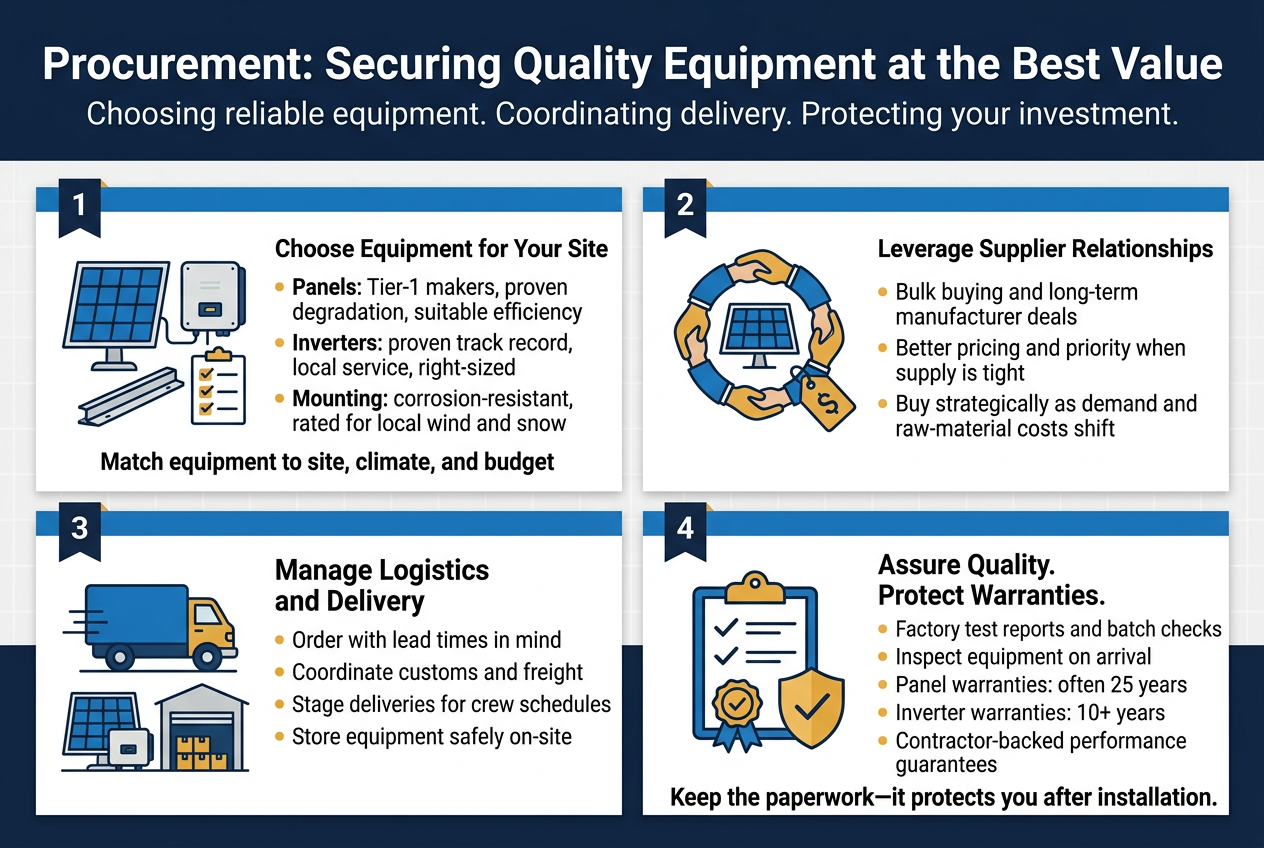
Choosing Reliable Panels, Inverters and Mounting Systems
A good solar EPC contractor picks equipment based on your site, climate and budget, not whatever’s sitting in their warehouse. Here’s what they check:
-
Panels: Tier-1 manufacturers, proven degradation rates and efficiency that fits your roof or land space.
-
Inverters: Strong track record, local service support and the right size for your system.
-
Mounting systems: Corrosion-resistant materials rated for your local wind and snow loads.
Leveraging Supplier Relationships for Better Pricing
An established solar EPC company buys in bulk and has long-standing deals with manufacturers. You get access to those prices, plus priority when supply gets tight. They also know when to buy, since panel prices swing with demand and raw material costs.
Managing Logistics and Delivery Schedules
Late equipment can stall a whole project. Your EPC partner handles:
-
Ordering with lead times in mind
-
Customs and freight coordination
-
Staged deliveries so materials arrive when crews need them
-
Safe on-site storage
Quality Assurance and Warranty Protection
Good procurement doesn’t stop at the purchase order. Look for:
-
Factory test reports and batch checks
-
Inspection of equipment on arrival
-
Clear product warranties (often 25 years for panels, 10+ for inverters)
-
Performance guarantees backed by the contractor
That paperwork protects you long after installation.
Construction: Delivering a Safe, On-Time Installation
Site Preparation and Civil Works
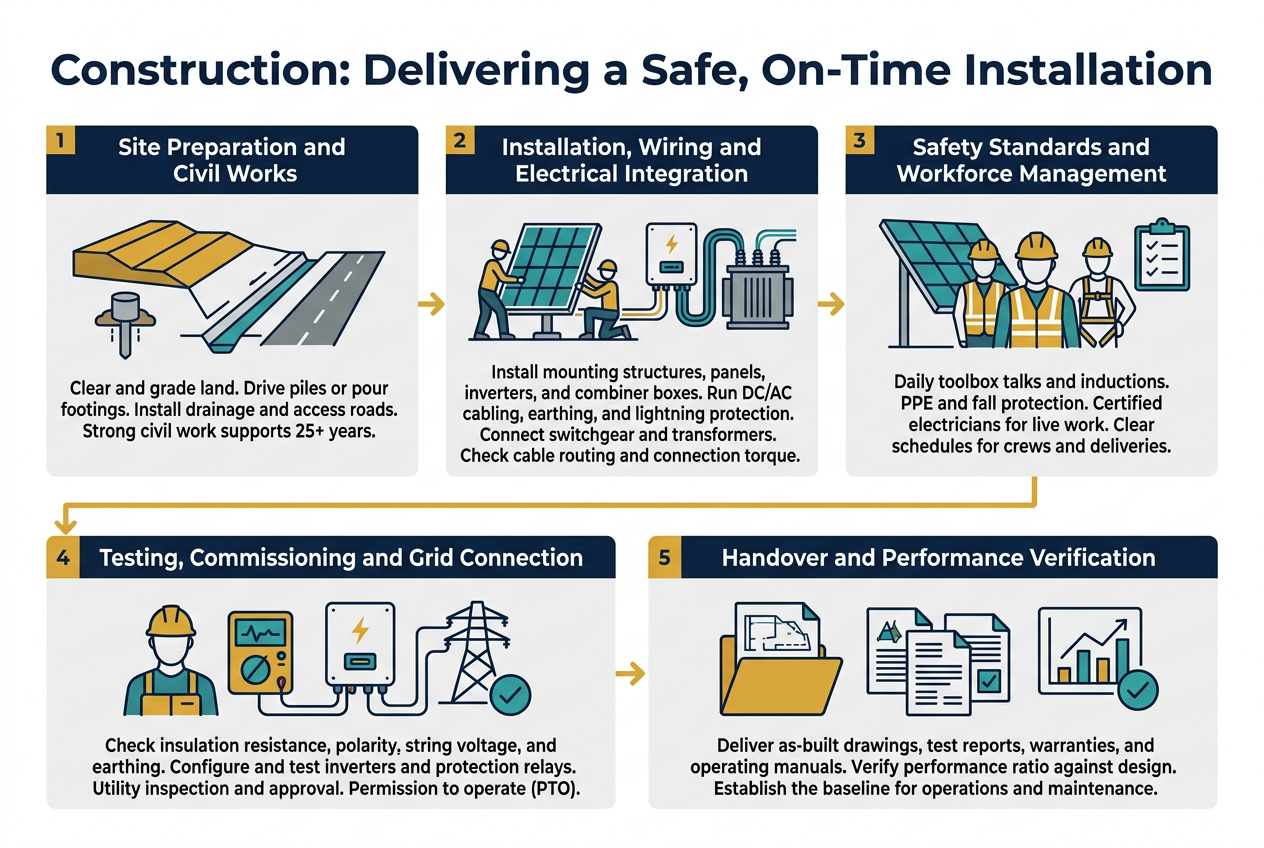
Before any panel goes up, the crew clears the land, grades it, and sets the foundations. Piles get driven or concrete footings poured, and drainage and access roads go in. Good civil work keeps the structure steady for 25+ years.
Installation, Wiring and Electrical Integration
Next comes the mounting structure, then panels, inverters, and combiner boxes. Your solar EPC contractor runs DC and AC cabling, sets up earthing and lightning protection, and ties everything into the switchgear and transformers. Neat cable routing and correct torque on every connection prevent trouble later.
Safety Standards and Workforce Management
A solid solar EPC company treats safety as a daily habit, not paperwork.
-
Daily toolbox talks and site inductions
-
Proper PPE and fall protection for rooftop and high-structure work
-
Certified electricians on all live work
-
Clear schedules so crews and deliveries don’t clash
Testing, Commissioning and Grid Connection
Before switching on, the team checks insulation resistance, polarity, string voltage, and earthing. Inverters and protection relays get configured and tested. Then the utility inspects the system, approves it, and you get permission to operate (PTO) to go live.
Handover and Performance Verification
At handover, you receive as-built drawings, test reports, warranties, and operating manuals. A performance ratio test confirms the plant delivers what the design promised. That sets a clean baseline for solar project operations and maintenance.
Key Benefits of Choosing a Solar EPC Contractor
Faster Project Timelines
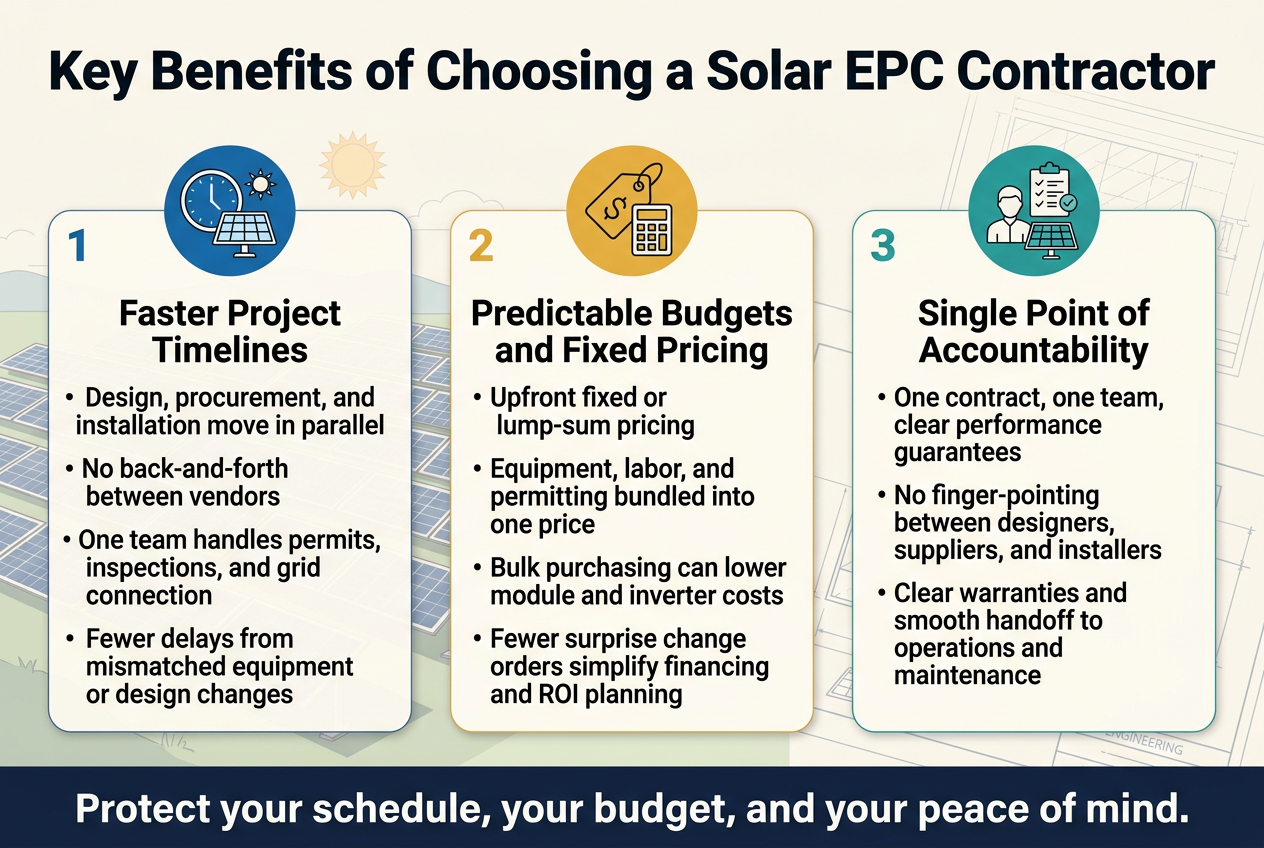
When one solar EPC contractor handles design, equipment orders, and installation, work overlaps instead of waiting in line. Procurement can start while final engineering is wrapping up, and crews can prep the site while panels are on the way.
-
No back-and-forth between separate vendors
-
Permits, inspections, and grid connection handled by one team
-
Fewer delays from mismatched equipment or design changes
Predictable Budgets and Fixed Pricing
Most turnkey solar EPC services use a fixed or lump-sum price. You know the cost upfront, and the contractor carries the risk of overruns.
-
Equipment, labor, and permitting costs are bundled into one number
-
Bulk purchasing power often lowers module and inverter prices
-
Fewer surprise change orders mean easier financing and ROI planning
Single Point of Accountability
If something goes wrong, you make one call. A solar EPC company owns the result, from the first drawing to the final commissioning test.
-
One contract, one team, one set of performance guarantees
-
No finger-pointing between designers, suppliers, and installers
-
Clear warranties and a smooth handoff to solar project operations and maintenance
That clarity protects your schedule, your budget, and your peace of mind.
Solar EPC Contract Models: Finding the Right Fit
Turnkey vs. Partial EPC Contracts
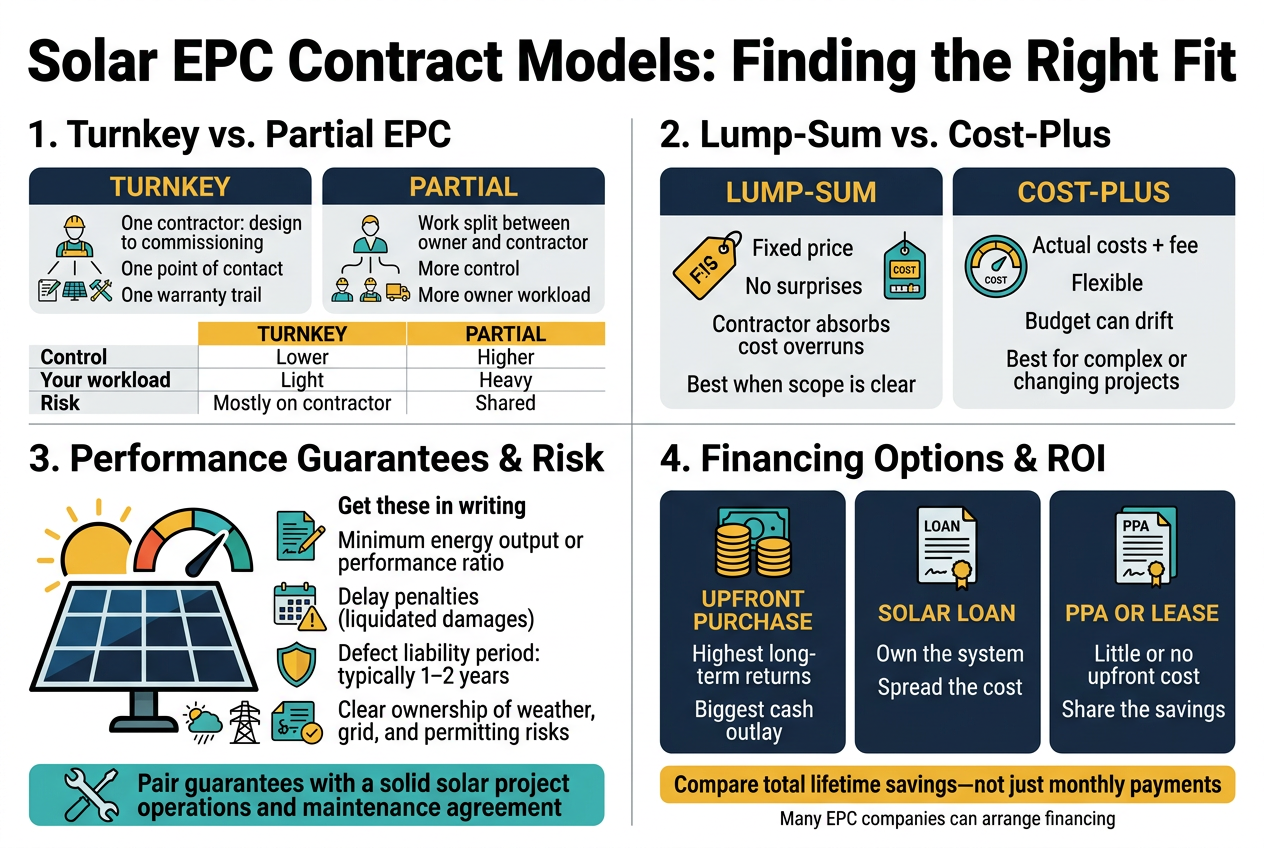
A turnkey solar EPC contract hands everything to one contractor, from design to commissioning. You get one point of contact and one warranty trail. Partial EPC splits the work. You might buy the panels yourself, or build the foundations with your own crew.
| Turnkey | Partial | |
|---|---|---|
| Control | Lower | Higher |
| Your workload | Light | Heavy |
| Risk | Mostly on contractor | Shared |
Lump-Sum vs. Cost-Plus Pricing
-
Lump-sum: Fixed price, so no surprises. The contractor eats cost overruns. Best when your scope is clear.
-
Cost-plus: You pay actual costs plus a fee. It’s flexible, but your budget can drift. Works for complex or changing projects.
Performance Guarantees and Risk Allocation
Ask for these in writing:
-
Minimum energy output or performance ratio guarantees
-
Delay penalties (liquidated damages)
-
Defect liability periods, typically 1–2 years
-
Clear ownership of weather, grid, and permitting risks
Pair guarantees with a solid solar project operations and maintenance agreement so performance holds up over time.
Financing Options That Improve Your ROI
-
Upfront purchase: Highest long-term returns, biggest cash outlay.
-
Solar loan: Own the system, spread the cost.
-
PPA or lease: Little or no upfront cost, but you share the savings.
Many EPC companies line up financing for you. Compare total lifetime savings, not just monthly payments.
How to Select the Best Solar EPC Partner
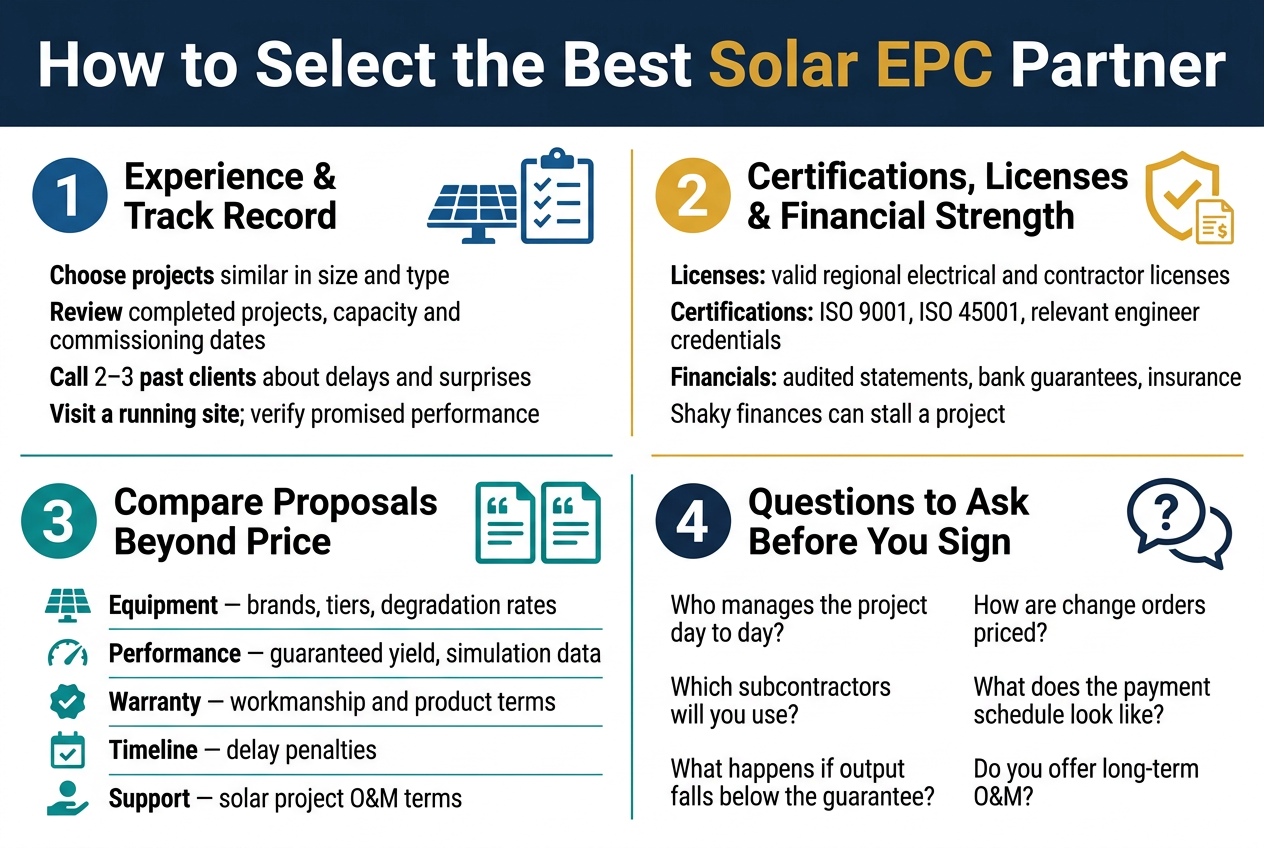
Evaluating Experience and Track Record
Start with projects similar to yours in size and type. A company that has built rooftop systems for factories may not be the right pick for a 50 MW ground-mounted plant.
-
Ask for a list of completed projects, with capacity and commissioning dates.
-
Call two or three past clients and ask about delays and surprises.
-
Visit a running site and check whether the system performs as promised.
Checking Certifications, Licenses and Financial Strength
A good solar EPC contractor should show proof, not just promises.
-
Licenses: valid electrical and contractor licenses for your region.
-
Certifications: ISO 9001, ISO 45001 and relevant engineer credentials.
-
Financials: audited statements, bank guarantees and insurance coverage.
A shaky balance sheet can stall your project halfway through.
Comparing Proposals Beyond Price
The lowest quote often hides cheaper panels or thin warranties. Line them up side by side:
| Factor | What to check |
|---|---|
| Equipment | Brands, tiers, degradation rates |
| Performance | Guaranteed yield, simulation data |
| Warranty | Workmanship and product terms |
| Timeline | Penalties for delays |
| Support | Solar project operations and maintenance terms |
Questions to Ask Before You Sign
-
Who manages the project day to day?
-
Which subcontractors will you use?
-
What happens if output falls below the guarantee?
-
How are change orders priced?
-
What does the payment schedule look like?
-
Do you offer long-term O&M?
Life After Installation: Protecting Your Investment
Operations and Maintenance Services
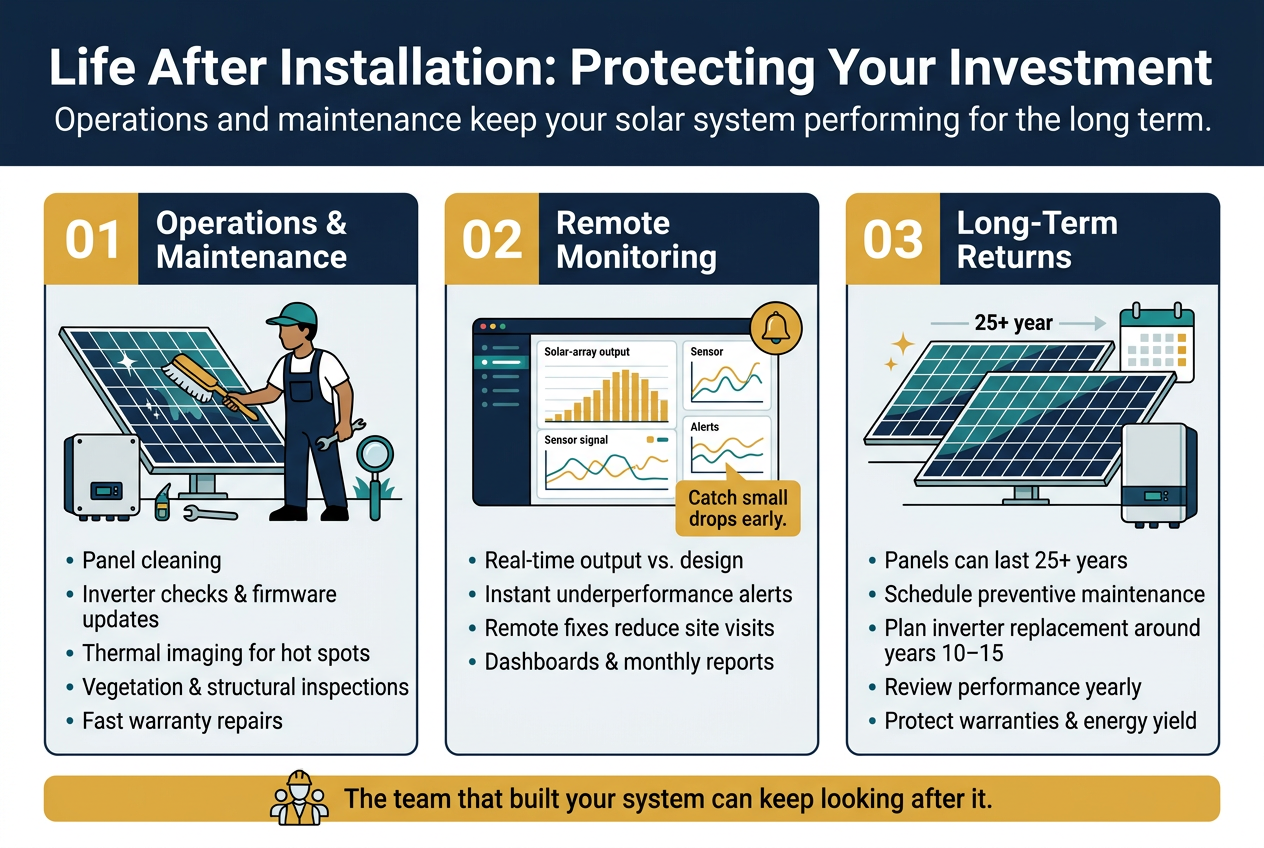
Your system doesn’t stop needing attention once the panels are up. A good solar EPC contractor offers solar project operations and maintenance (O&M) so you don’t have to figure it out alone. Typical services include:
-
Panel cleaning to clear dust, bird droppings, and debris
-
Inverter checks and firmware updates
-
Thermal imaging to spot hot spots and loose connections
-
Vegetation control and structural inspections
-
Fast repairs under warranty
Remote Monitoring for Peak Performance
Think of monitoring as a fitness tracker for your plant. Sensors and software track output in real time, comparing it against what the design predicted.
-
Instant alerts when a string, inverter, or panel underperforms
-
Fewer site visits, since many faults get fixed remotely
-
Clear dashboards and monthly reports for owners and lenders
Catching a small drop early keeps it from turning into weeks of lost generation.
Maximizing Long-Term Returns and System Lifespan
Solar panels often last 25 years or more, but only with steady care. Consistent O&M slows degradation, protects warranties, and keeps energy yield close to the original projections.
-
Schedule preventive maintenance rather than waiting for failures
-
Plan inverter replacement, usually around year 10–15
-
Review performance data yearly to find upgrade opportunities
Sticking with your EPC partner for O&M also means the people who built your system are the ones looking after it.
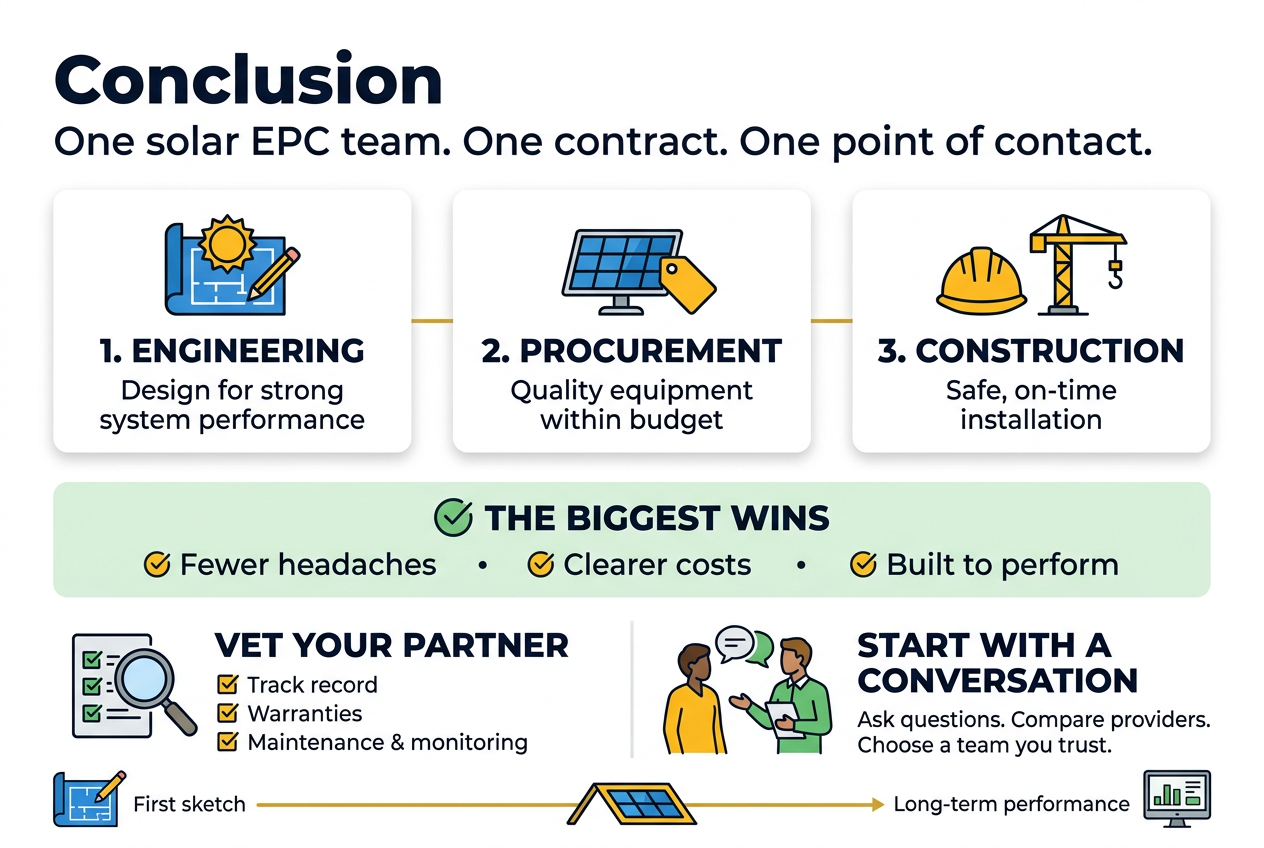
Going solar doesn’t have to mean juggling designers, suppliers, and installers on your own. A solar EPC contractor handles it all: smart engineering that gets the most out of your system, procurement that puts quality equipment in your budget, and construction that’s safe and done on time. One team, one contract, and one point of contact when questions come up.
The biggest wins are fewer headaches, clearer costs, and a system built to perform. Pick the contract model that fits your project, and take your time vetting partners. Check their track record, ask about warranties, and make sure they’ll stick around for maintenance and monitoring after the panels go up. That support is what protects your investment for decades.
So if you’re planning a solar project, start by talking to a few EPC providers. Ask plenty of questions, compare their answers, and go with the team you trust to see it through from first sketch to long-term performance.