
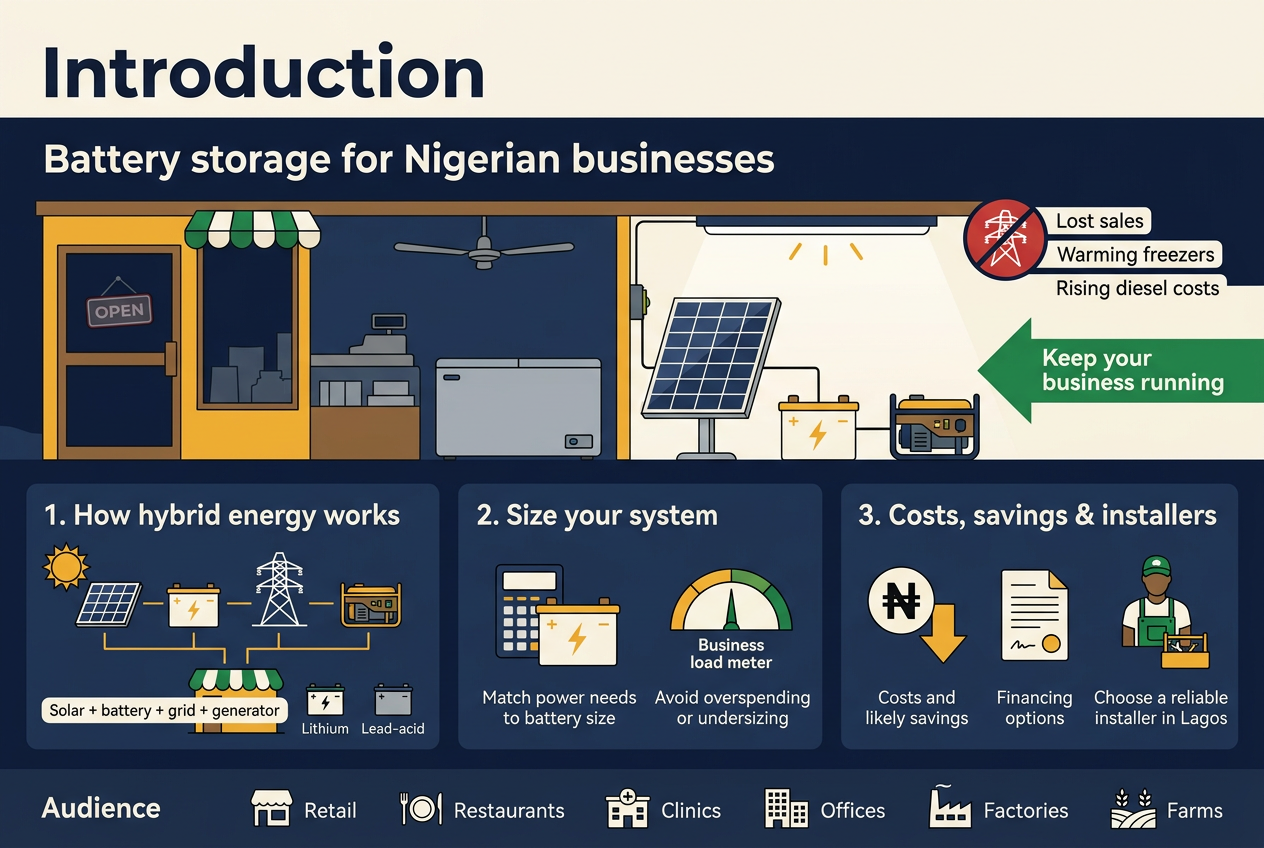
Power cuts cost you money. Every hour the grid is down, your shop stops selling, your freezers warm up, and your diesel bill climbs. Battery storage in Nigeria is one way to stop that cycle, and this guide shows you how it works.
This guide is for business owners, facility managers, and operations heads in Nigeria. That includes retail shops, restaurants, clinics, offices, factories, and farms. If you’re tired of generator noise and fuel costs, you’re in the right place.
We’ll keep it simple and cover:
-
How hybrid energy systems for businesses work. We’ll explain how solar, batteries, the grid, and a generator share the load, and how to pick between lithium and lead-acid batteries.
-
How to size a solar battery system. You’ll learn how to work out your power needs so you don’t overspend or end up with a system that’s too small.
-
What it costs and how to pay for it. We’ll look at hybrid solar system costs in Nigeria, likely savings, financing options, and how to choose a reliable installer, including tips for finding one in Lagos.
Let’s get into it.
Why Nigerian Businesses Need Reliable Backup Power
Cut Losses From Grid Instability and Outages
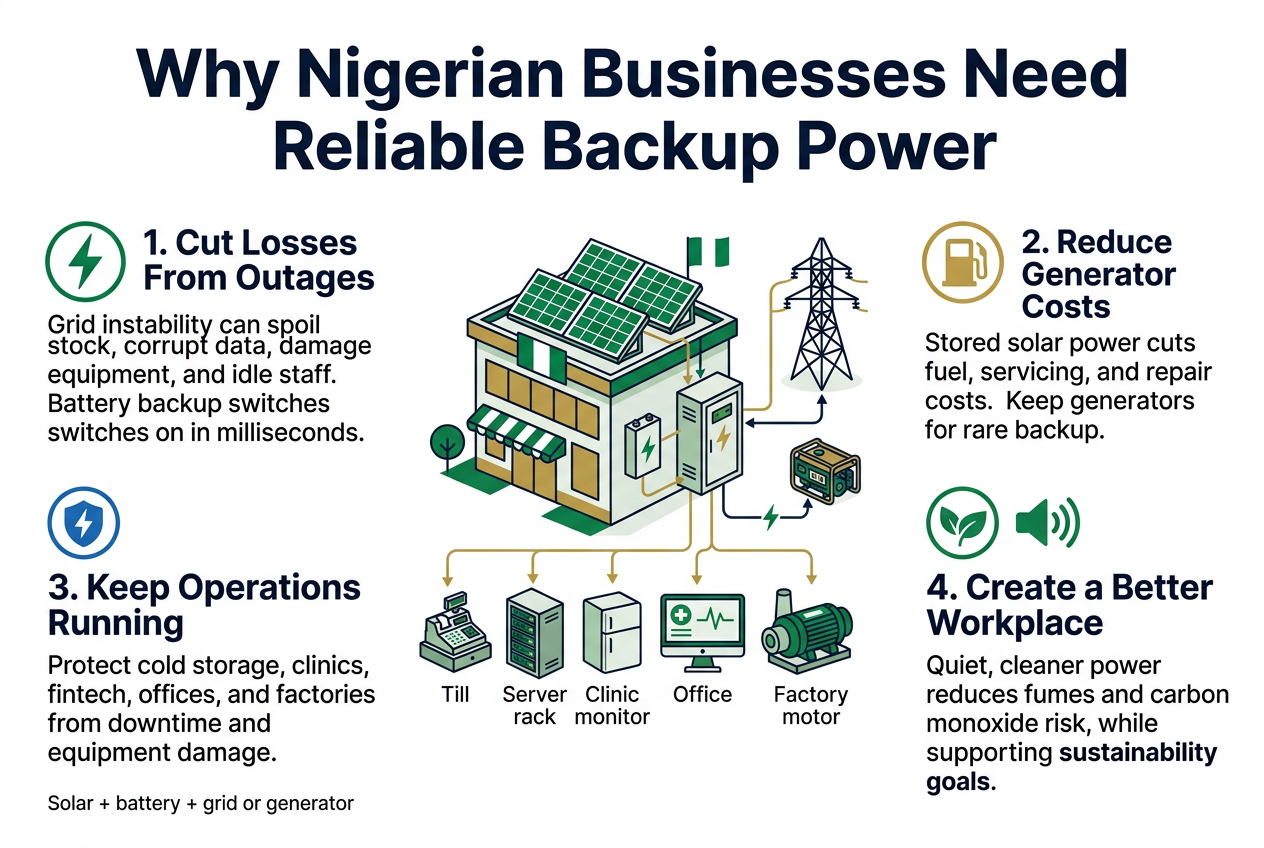
Nigeria’s grid collapses several times a year, and daily blackouts are routine for many businesses. Each outage can mean spoiled stock, corrupted data, damaged equipment, and idle staff you still have to pay. A battery storage system switches on within milliseconds, so your tills, servers, and machines keep running through a blackout.
Reduce Rising Diesel and Petrol Generator Costs
Fuel prices keep climbing, and generators eat into your margins through fuel, servicing, and repairs. Many small businesses spend more on fuel than they expect once they add it all up. A commercial solar battery backup in Nigeria cuts that spend by running your essentials on stored solar power. The generator becomes a rare backup instead of your main source.
Meet Operational Demands Without Interruption
Some businesses can’t afford even a short blackout:
-
Cold storage and food vendors: protect perishable goods.
-
Clinics and labs: keep critical equipment on.
-
Banks, fintechs, and offices: avoid downtime and lost transactions.
-
Factories: prevent production stoppages and motor damage.
Hybrid energy systems for businesses combine solar, batteries, and the grid (or a generator) so power stays steady around the clock.
Lower Noise and Emissions for a Better Workplace
Generators are loud and their fumes are harmful. Quiet solar-and-battery systems make workplaces more comfortable for staff and customers, cut carbon monoxide risk, and help you meet the sustainability expectations of partners and investors.
Understanding Battery Storage and Hybrid Energy Systems
A. How Battery Storage Keeps Your Business Running
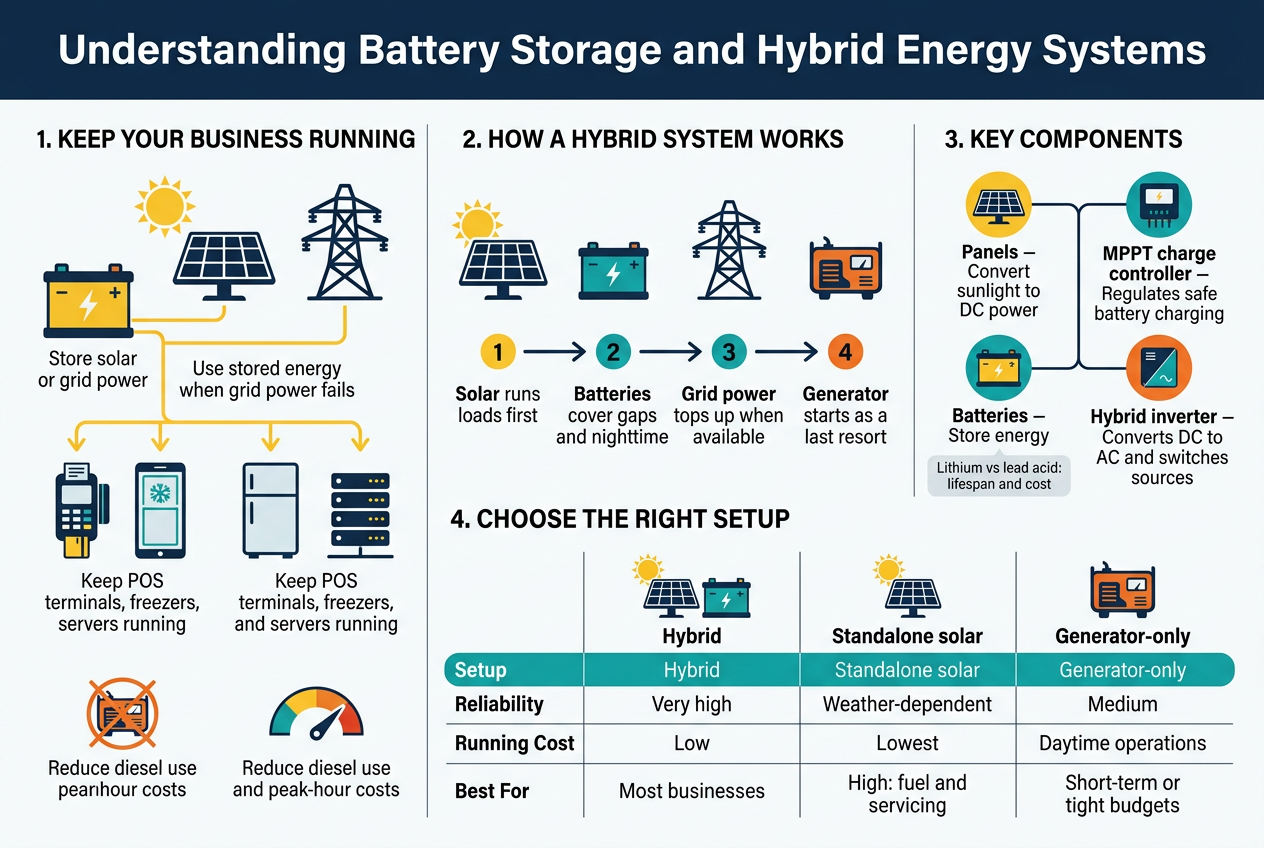
Batteries store power from solar or the grid, then release it when NEPA takes light. Your POS terminals, freezers, and servers keep running, and you burn less diesel. A solar inverter battery for business also shaves peak-hour costs by letting you use stored energy instead of expensive generator fuel.
B. What Makes a Hybrid System Combine Solar, Grid, and Generator
A hybrid system manages three sources and picks the cheapest available one:
-
Solar runs your loads first during the day.
-
Batteries cover the gaps and the night.
-
Grid power tops up when available.
-
The generator starts only as a last resort.
C. Key Components: Inverters, Batteries, Panels, and Controllers
-
Panels: Turn sunlight into DC power.
-
Charge controllers (MPPT): Regulate that power so batteries charge safely.
-
Batteries: Store energy. The lithium vs lead acid choice in Nigeria affects lifespan and cost.
-
Hybrid inverter: Converts DC to AC and switches between sources.
D. Hybrid vs Standalone Solar vs Generator-Only Setups
| Setup | Reliability | Running Cost | Best For |
|---|---|---|---|
| Hybrid | Very high | Low | Most businesses |
| Standalone solar | Weather-dependent | Lowest | Daytime operations |
| Generator-only | Medium | High (fuel, servicing) | Short-term or tight budgets |
Choosing the Right Battery Technology
Lithium-Ion Batteries for Long Life and Efficiency
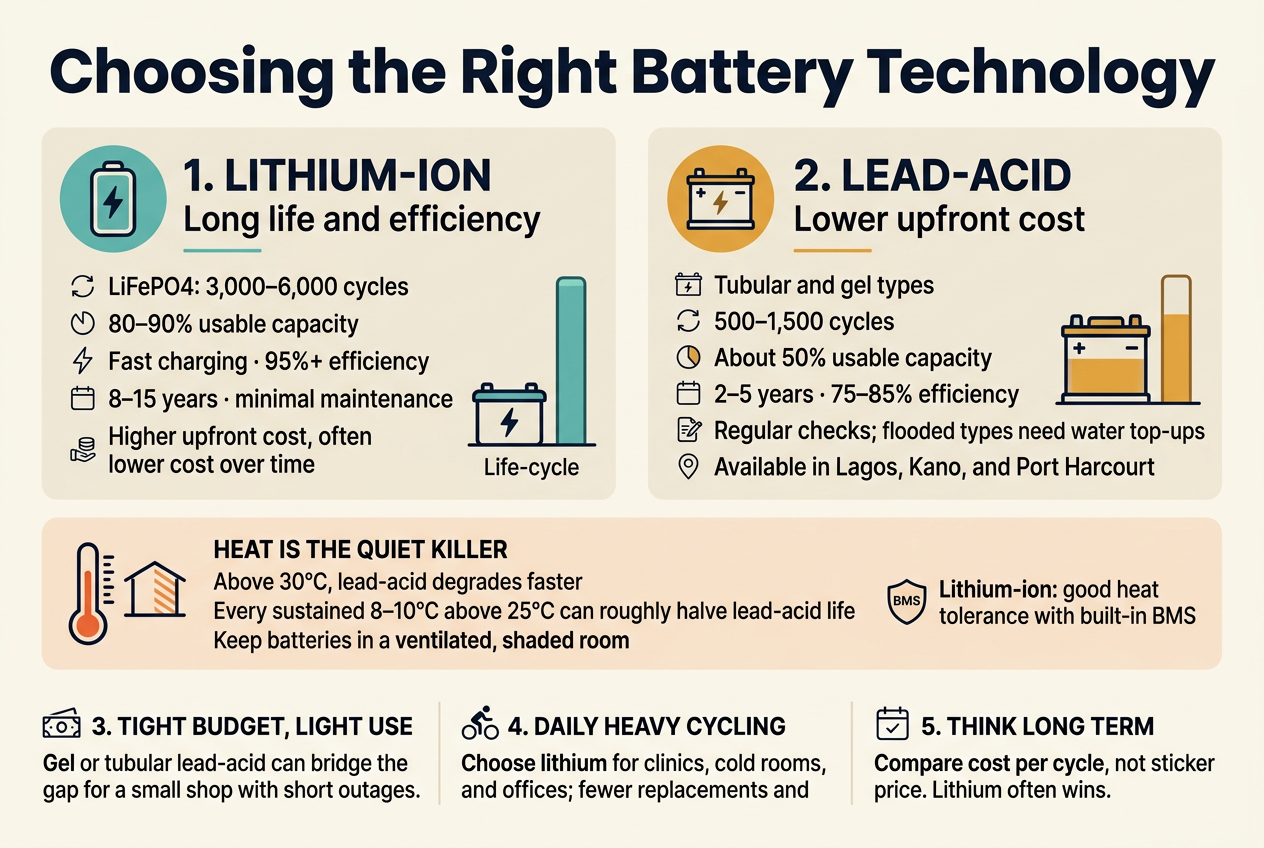
Lithium-ion (especially LiFePO4) batteries last 3,000-6,000 cycles, handle deep discharge (80-90%), and charge fast. They’re compact and need almost no upkeep. They cost more upfront, but they usually pay back over time.
Lead-Acid Batteries for Lower Upfront Cost
Tubular and gel lead-acid batteries are easy to find in Lagos, Kano, and Port Harcourt, and any local technician can service them. Expect 500-1,500 cycles and a safe discharge of only 50%, so you need more capacity for the same usable power.
Comparing Lifespan, Maintenance, and Performance in Nigerian Heat
| Factor | Lithium-Ion | Lead-Acid |
|---|---|---|
| Lifespan | 8-15 years | 2-5 years |
| Usable capacity | 80-90% | ~50% |
| Maintenance | Minimal | Regular checks, water top-ups (flooded types) |
| Heat tolerance | Good, with built-in BMS | Degrades fast above 30°C |
| Efficiency | 95%+ | 75-85% |
Heat is the quiet killer. Every sustained 8-10°C above 25°C can roughly halve lead-acid life. Keep any battery in a ventilated, shaded room.
Matching Battery Type to Your Business Budget
-
Tight budget, light usage: Gel or tubular lead-acid can bridge the gap, such as for a small shop with short outages.
-
Daily heavy cycling: Go lithium. Clinics, cold rooms, and offices running on batteries every day save more on replacements and diesel.
-
Long-term thinking: Compare cost per cycle, not sticker price. Lithium often wins.
Sizing a System That Fits Your Business Needs
Calculate Your Daily Energy Consumption
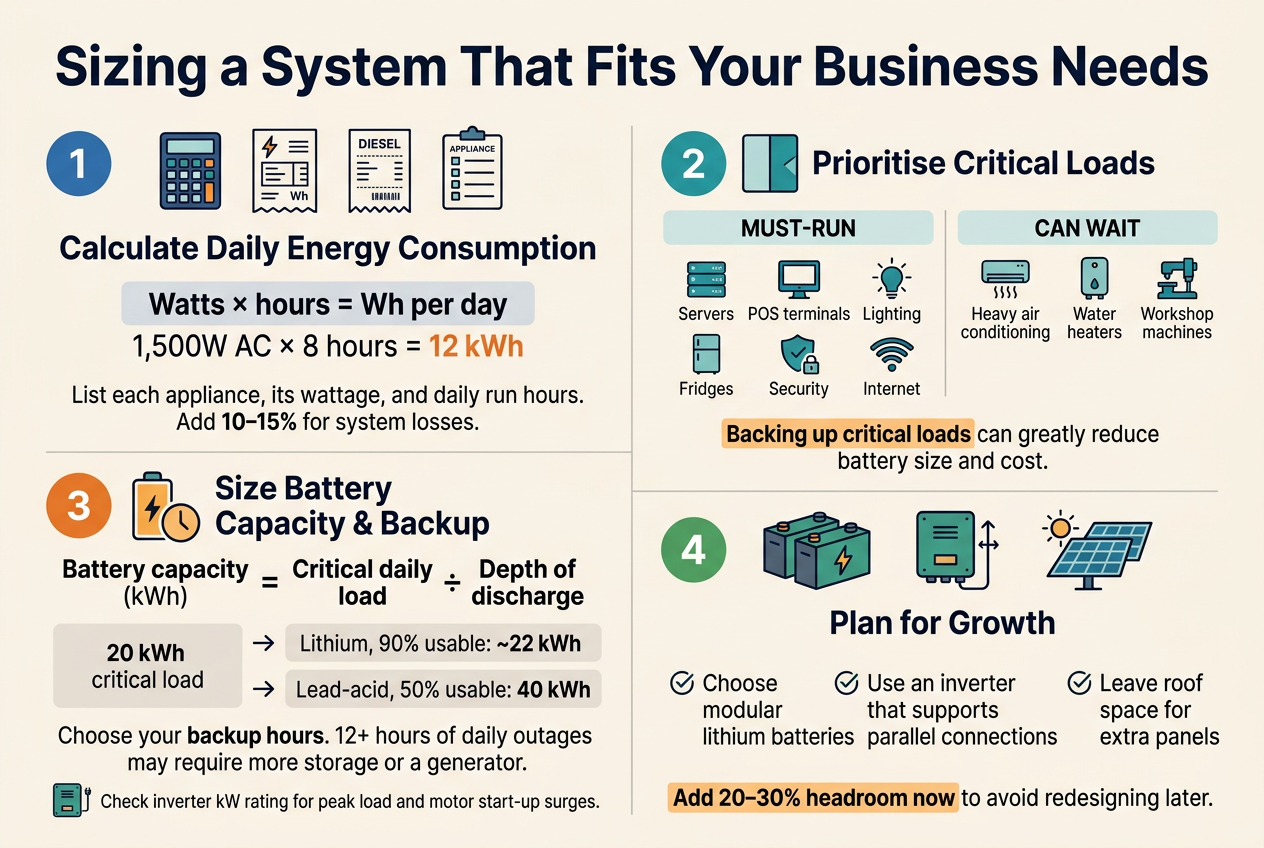
Start with your last few electricity bills and your diesel receipts. Then list every appliance, its wattage, and the hours it runs daily.
Watts × hours = Wh per day
For example, a 1,500W AC running 8 hours uses 12 kWh. Add up everything, then add 10–15% for system losses.
Identify Critical Loads to Prioritise
You don’t need to back up everything. Split your loads into two groups:
-
Must-run: servers, POS terminals, lighting, fridges, security systems, internet
-
Can wait: heavy air conditioning, water heaters, workshop machines
Backing up only critical loads can cut your battery size, and cost, by a big margin.
Determine Battery Capacity and Backup Duration
Use this formula:
Battery capacity (kWh) = Critical daily load ÷ Depth of discharge
If your critical load is 20 kWh and you use lithium (about 90% usable), you need roughly 22 kWh. Lead-acid (about 50%) needs 40 kWh.
Decide how many hours of backup you want. Areas with 12+ hours of daily outages need more storage or a generator in the mix. Also check that your inverter’s kW rating handles your peak load, including motor start-up surges.
Plan for Future Growth and Expansion
Choose modular lithium batteries and an inverter that supports parallel connections. Leave roof space for extra panels. Adding 20–30% headroom now is cheaper than redesigning later.
Hybrid System Configurations for Different Business Types
Small Shops and Offices
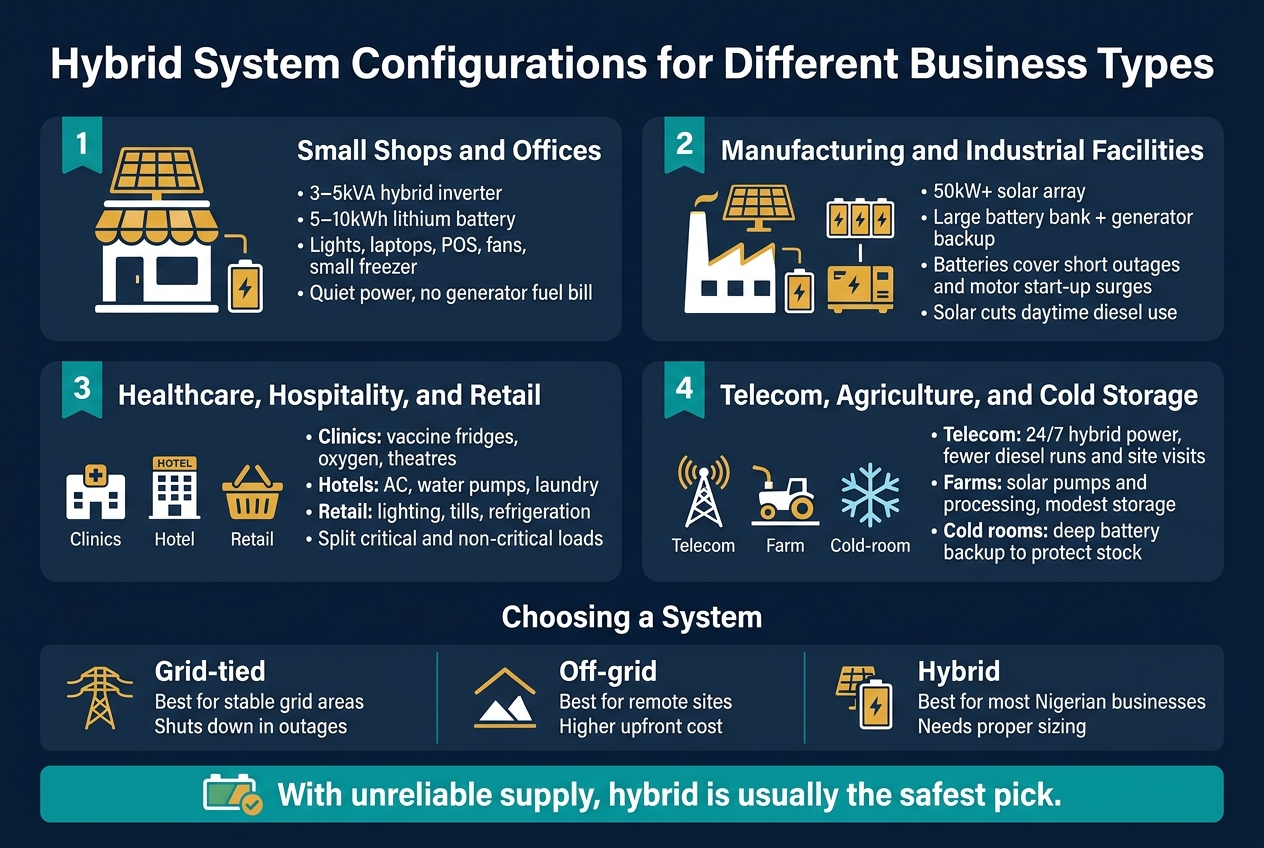
A 3–5kVA hybrid inverter with a 5–10kWh lithium battery and a few solar panels usually does the job. It runs lights, laptops, POS machines, fans, and a small freezer without the generator’s noise or fuel bill.
Manufacturing and Industrial Facilities
Factories need scale. Pair a 50kW+ solar array with a large battery bank and keep the generator as a backup. Batteries cover short outages and smooth out motor start-up surges, while solar cuts daytime diesel use.
Healthcare, Hospitality, and Retail Businesses
-
Clinics: Prioritize uninterrupted power for vaccine fridges, oxygen concentrators, and theatres.
-
Hotels: Cover AC, water pumps, and laundry, and keep guests comfortable overnight.
-
Retail: Protect lighting, tills, and refrigeration during peak trading hours.
Split critical and non-critical loads so the battery isn’t drained by things that can wait.
Telecom, Agriculture, and Cold Storage Operations
-
Telecom towers: Run 24/7, so solar-battery-generator hybrids cut diesel runs and site visits.
-
Farms: Solar pumps and processing equipment work best with modest storage.
-
Cold rooms: Need deep battery backup, since a few hours without power can spoil stock.
Choosing Between Grid-Tied, Off-Grid, and Hybrid Designs
| Design | Best For | Catch |
|---|---|---|
| Grid-tied | Stable grid areas | Shuts down in outages |
| Off-grid | Remote sites | Higher upfront cost |
| Hybrid | Most Nigerian businesses | Needs proper sizing |
With unreliable supply, hybrid is usually the safest pick.
Understanding Costs, Savings, and Return on Investment
Breaking Down Upfront Equipment and Installation Costs
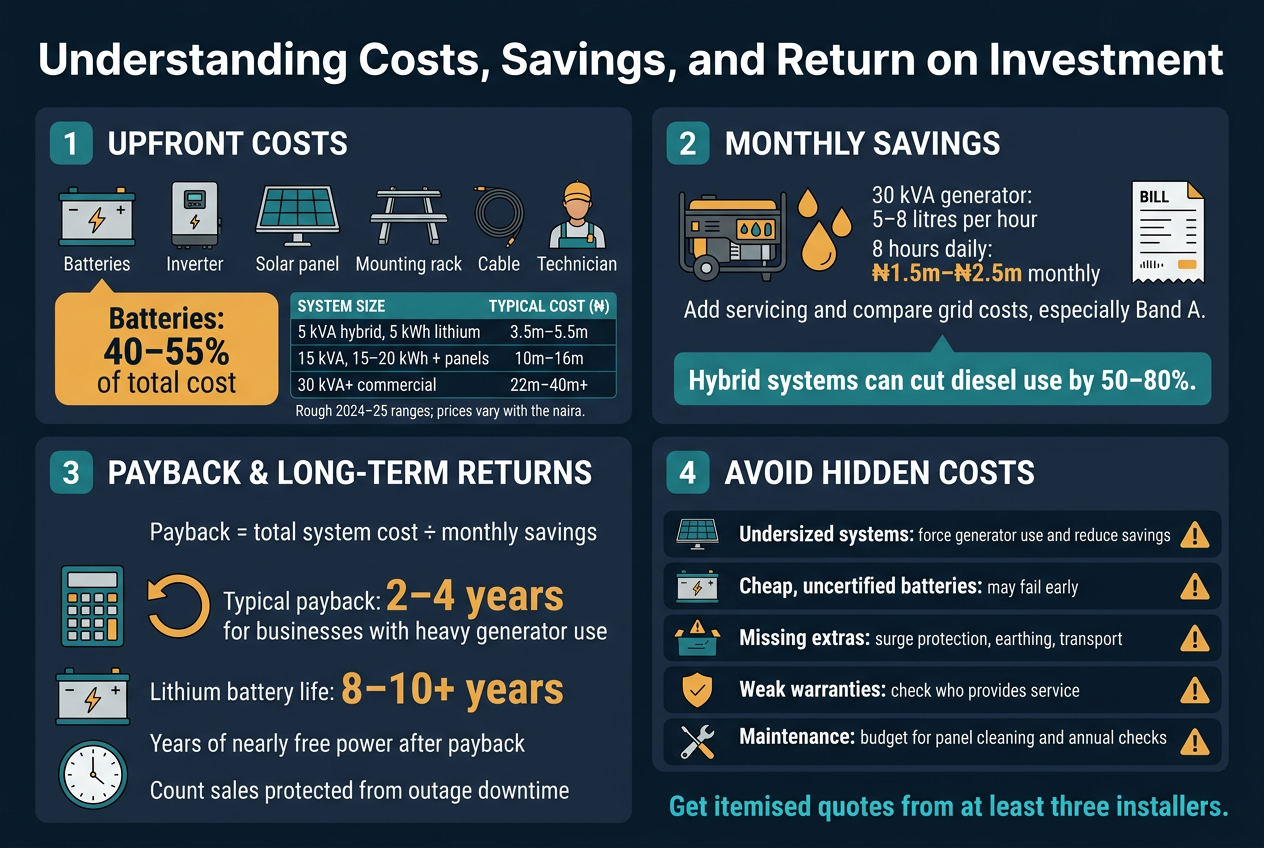
Your biggest spend is the batteries, usually 40-55% of the total. The rest covers inverters, solar panels, mounting, cabling, and labour. Rough 2024-25 ranges (prices swing with the naira):
| System size | Typical cost (₦) |
|---|---|
| 5 kVA hybrid, 5 kWh lithium | 3.5m-5.5m |
| 15 kVA, 15-20 kWh + panels | 10m-16m |
| 30 kVA+ commercial | 22m-40m+ |
Calculating Monthly Savings on Fuel and Electricity
Start with your diesel bill. A 30 kVA generator can burn 5-8 litres an hour, so a business running it 8 hours daily may spend ₦1.5m-₦2.5m monthly. Add generator servicing, then compare with grid costs, especially if you’re on Band A tariffs. Hybrid systems often cut diesel use by 50-80%.
Estimating Payback Period and Long-Term Returns
Divide total system cost by monthly savings. Many businesses with heavy generator use see payback in 2-4 years. Lithium batteries last 8-10+ years, so you get years of nearly free power afterward. Also count avoided downtime, since lost sales during outages add up fast.
Avoiding Hidden Costs
-
Undersized systems: They force generator use and kill savings.
-
Cheap, uncertified batteries: They fail early.
-
Missing extras: Surge protection, earthing, and transport.
-
Weak warranties: Check who actually services them.
-
Maintenance: Budget for panel cleaning and annual checks.
Get itemised quotes from at least three installers.
Financing Options and Incentives Available in Nigeria
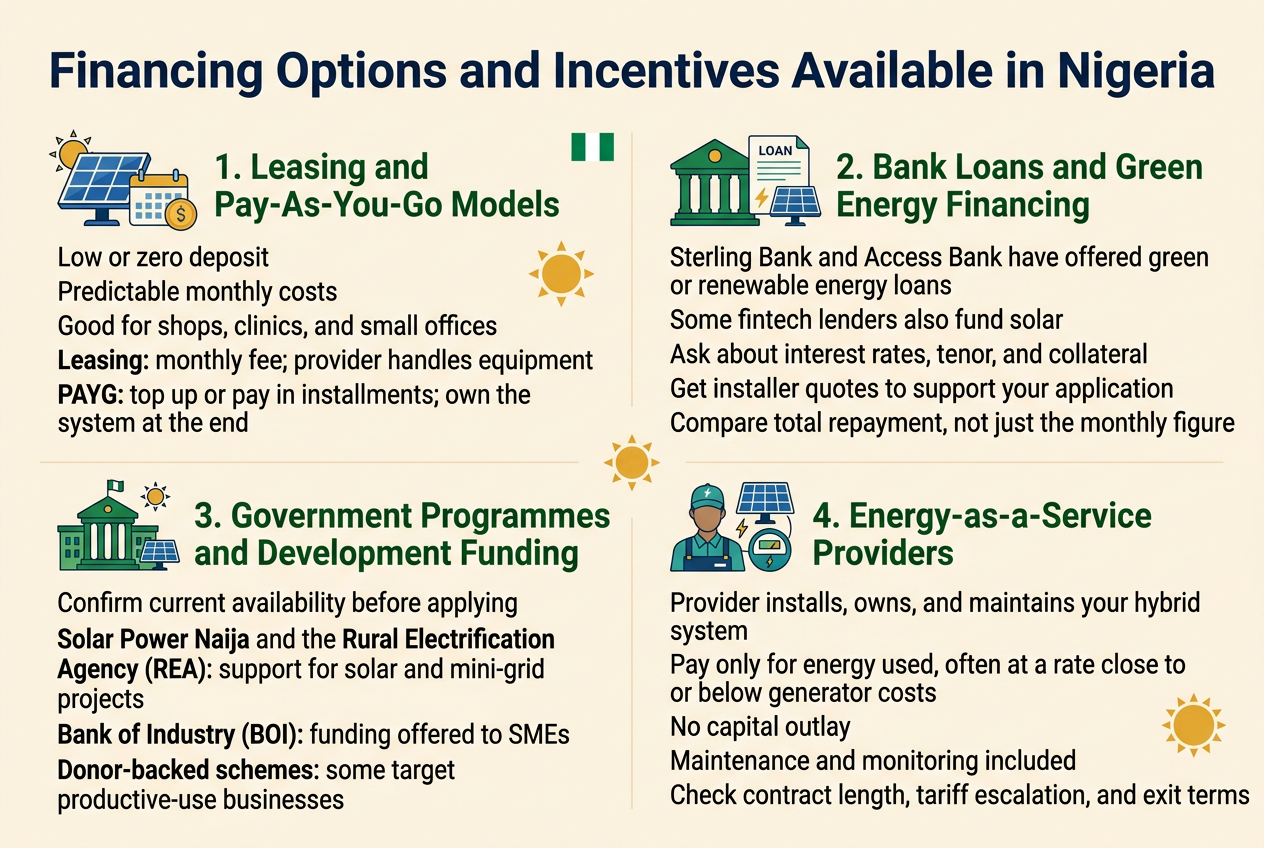
Leasing and Pay-As-You-Go Models
Can’t afford the upfront cost? Leasing spreads it out. You pay a monthly fee, and the provider handles the equipment. Pay-as-you-go (PAYG) works similarly: you top up or pay in installments and own the system at the end.
-
Low or zero deposit
-
Predictable monthly costs
-
Good for shops, clinics, and small offices
Bank Loans and Green Energy Financing
Commercial solar financing in Nigeria is growing. Banks like Sterling Bank and Access Bank have offered green or renewable energy loans, and some fintech lenders now fund solar too.
-
Ask about interest rates, tenor, and collateral
-
Get quotes from your installer to support the application
-
Compare total repayment, not just the monthly figure
Government Programmes and Development Funding
Programmes change, so confirm current availability before you apply.
-
Solar Power Naija and the Rural Electrification Agency (REA): Support for solar and mini-grid projects
-
Development finance institutions: Bodies like the Bank of Industry (BOI) have offered funding to SMEs
-
Donor-backed schemes: Some target productive-use businesses
Energy-as-a-Service Providers
Here, a provider installs, owns, and maintains your hybrid system. You pay only for the energy you use, often at a rate close to or below your generator costs.
-
No capital outlay
-
Maintenance and monitoring included
-
Check contract length, tariff escalation, and exit terms
Selecting a Trusted Supplier and Installer
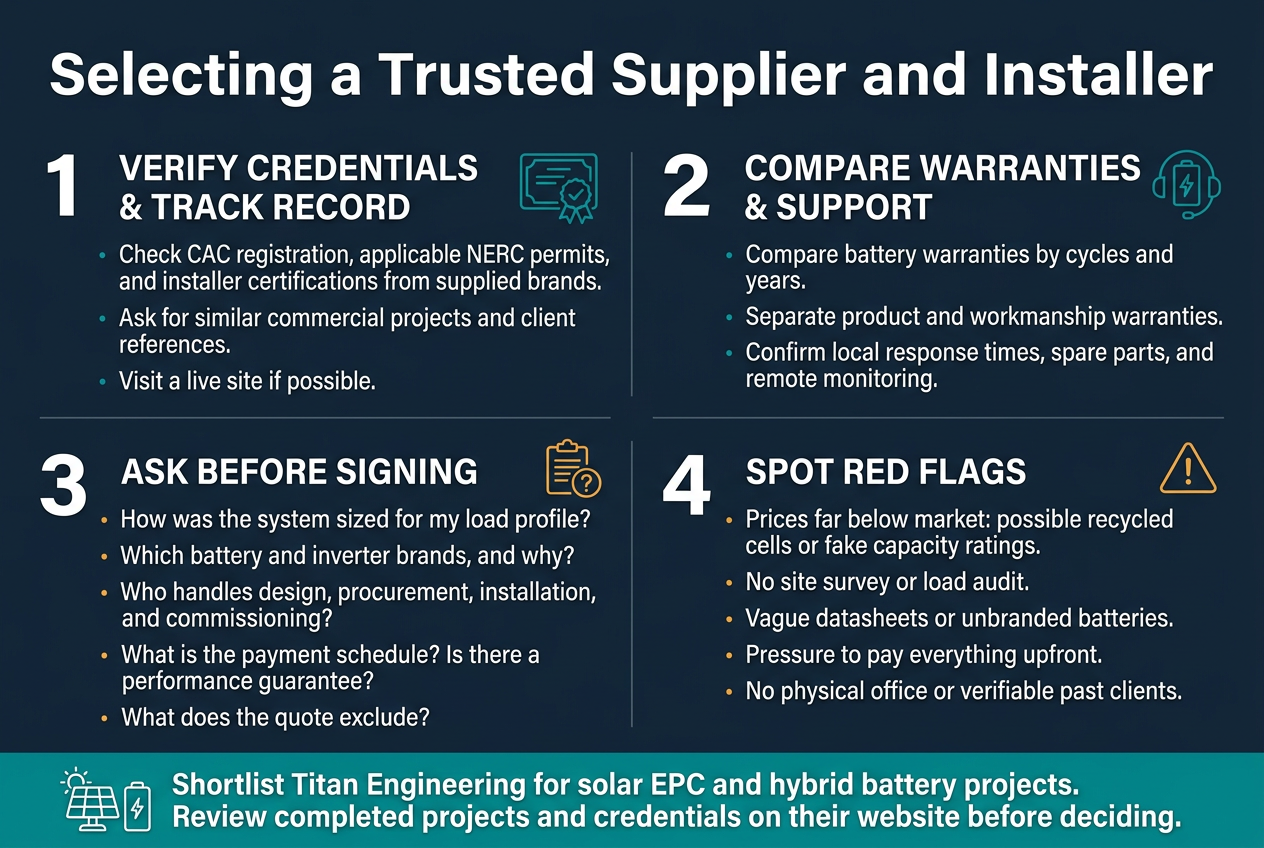
Verify Certifications, Experience, and Track Record
-
Check CAC registration, NERC permits where applicable, and installer certifications from the brands they supply.
-
Ask for commercial projects similar to yours, plus client references you can call.
-
Visit a live site if you can.
Titan Engineering is worth adding to your shortlist for solar EPC and hybrid battery projects. Review their website for completed projects and credentials before you decide.
Compare Warranties and After-Sales Support
-
Compare battery warranties by cycles and years, not just years.
-
Separate product warranty from workmanship warranty.
-
Confirm local service response times and spare parts availability.
-
Ask if remote monitoring is included.
Ask the Right Questions Before Signing
-
How did you size the system for my load profile?
-
Which battery and inverter brands will you use, and why?
-
Who handles design, procurement, installation, and commissioning?
-
What’s the payment schedule? Is there a performance guarantee?
-
What does the quote exclude?
Spot Red Flags and Substandard Products
-
Prices far below market, which often means recycled cells or fake capacity ratings.
-
No site survey or load audit before quoting.
-
Vague datasheets or unbranded batteries.
-
Pressure to pay everything upfront.
-
No physical office, or no verifiable past clients.
Installation, Maintenance, and Performance Monitoring
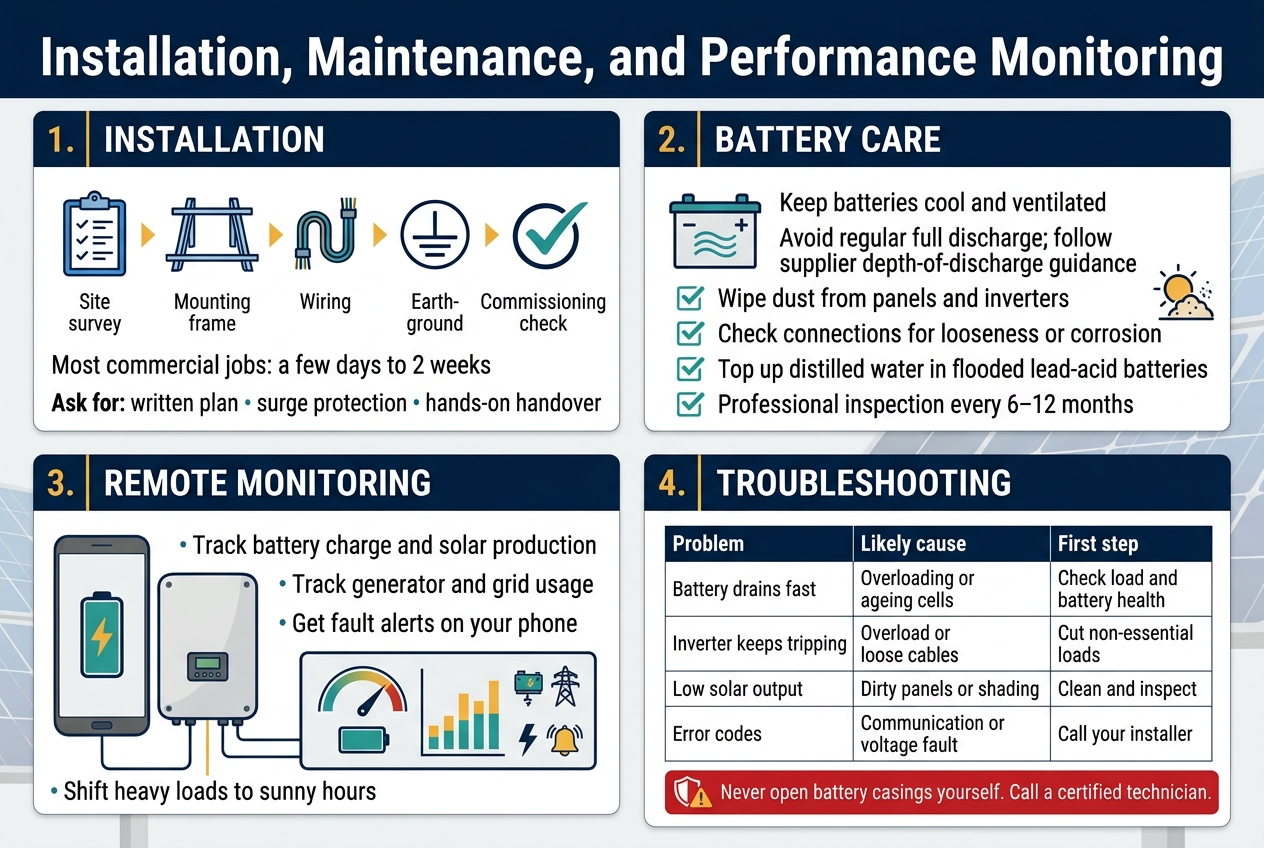
A. What to Expect During Installation
A good installer starts with a site survey, then handles mounting, wiring, earthing, and commissioning. Most commercial jobs take a few days to two weeks, depending on size. Ask for a written plan, proper surge protection, and a hands-on handover where your team learns how the system works.
B. Simple Maintenance Habits to Extend Battery Life
-
Keep batteries in a cool, ventilated room. Heat kills them faster than anything else.
-
Avoid regularly draining them to empty. Stick to the depth of discharge your supplier recommends.
-
Wipe dust off panels and inverters. Harmattan dust cuts solar output noticeably.
-
Check connections for looseness or corrosion.
-
Top up distilled water in flooded lead-acid batteries.
-
Book a professional inspection every 6 to 12 months.
C. Remote Monitoring Tools to Maximise Efficiency
Most modern solar inverter batteries for business come with an app or web dashboard. You can track:
-
Battery charge level and solar production
-
Generator and grid usage
-
Fault alerts sent straight to your phone
Watching this data helps you shift heavy loads to sunny hours and spot problems early.
D. Troubleshooting Common System Issues
| Problem | Likely cause | First step |
|---|---|---|
| Battery drains fast | Overloading or ageing cells | Check load and battery health |
| Inverter keeps tripping | Overload or loose cables | Cut non-essential loads |
| Low solar output | Dirty panels or shading | Clean and inspect |
| Error codes | Communication or voltage fault | Call your installer |
Never open battery casings yourself. Call a certified technician.
Navigating Regulations and Future Trends
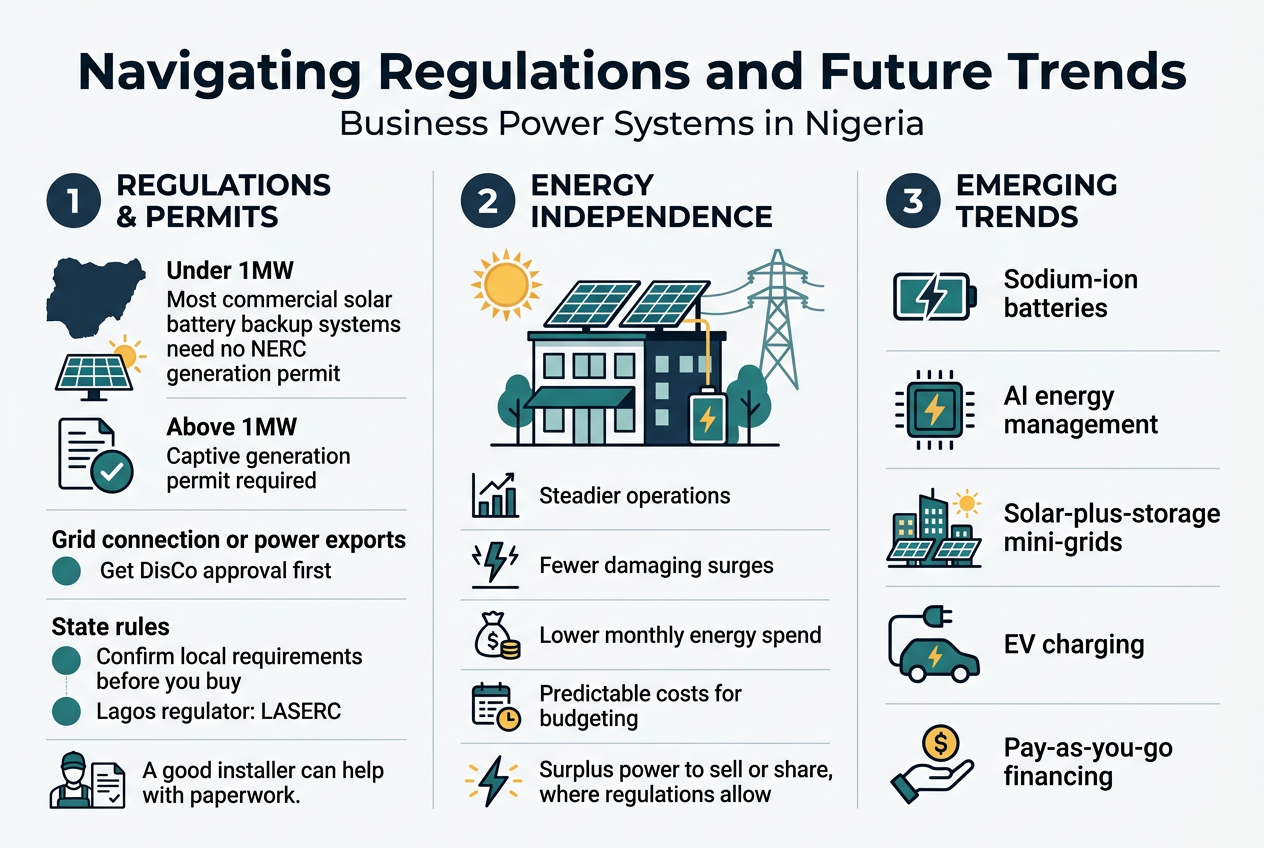
Understanding NERC Rules and Permits for Business Power Systems
Under the Electricity Act 2023, power regulation is no longer only federal. States can now regulate their own markets, and Lagos already has its own regulator, LASERC. Here’s what to check:
-
Under 1MW: Most commercial solar battery backup systems in Nigeria need no NERC generation permit.
-
Above 1MW: You’ll need a captive generation permit.
-
Exporting power or connecting to the grid: Get your DisCo’s approval first.
-
State rules: Confirm local requirements before you buy.
A good solar installer in Lagos or elsewhere will handle the paperwork with you.
Benefits of Embedded Generation and Energy Independence
Generating power on-site cuts your exposure to grid outages and rising diesel prices. You get:
-
Steadier operations and fewer equipment-damaging surges
-
Lower monthly energy spend
-
Predictable costs for budgeting
-
Surplus power you may be able to sell or share, where regulations allow
Emerging Technologies Shaping Nigeria’s Energy Landscape
Watch these trends:
-
Sodium-ion batteries: A potentially cheaper alternative to lithium.
-
AI energy management: Software that decides when to charge, discharge, or switch sources.
-
Solar-plus-storage mini-grids: These can power industrial clusters and markets.
-
EV charging: A new revenue stream for businesses with spare capacity.
-
Pay-as-you-go financing: It lowers the upfront cost of hybrid systems.
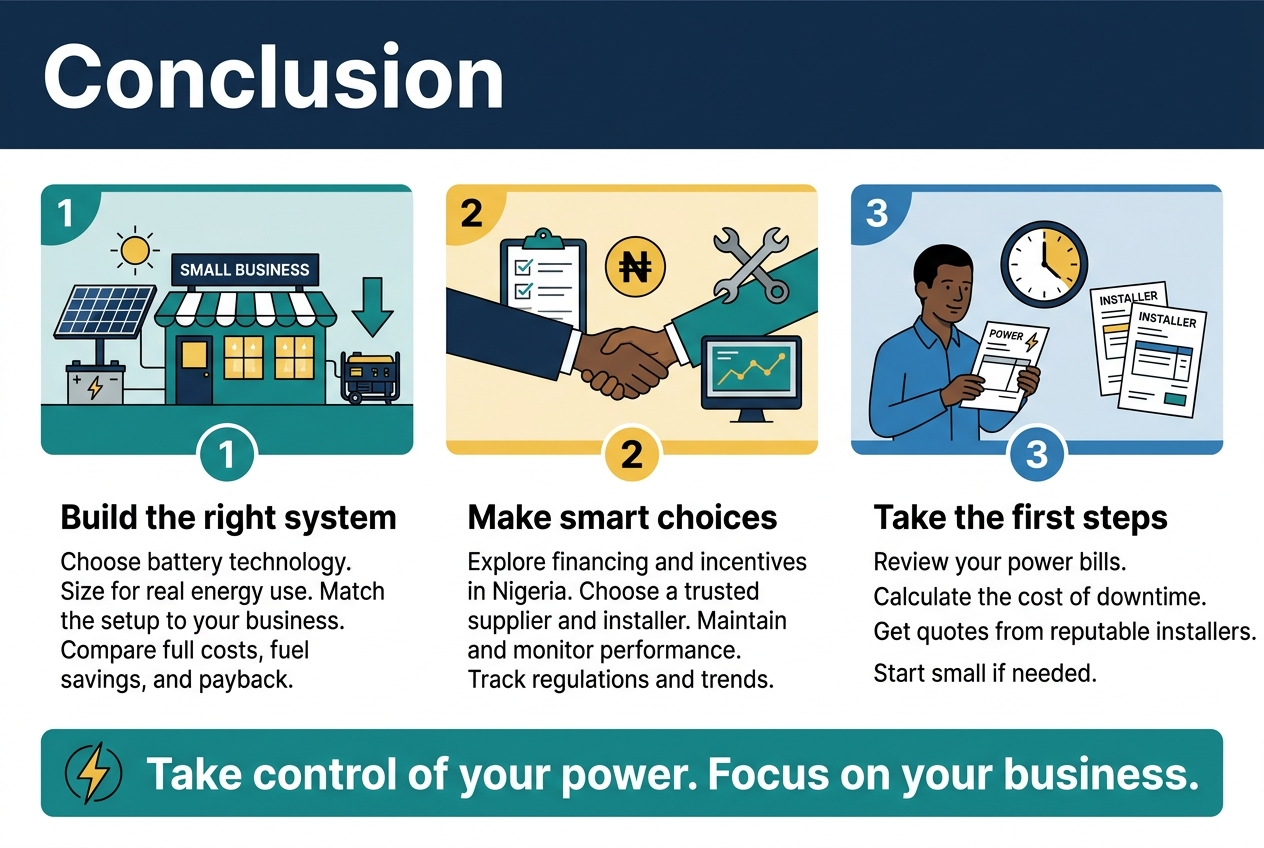
Power cuts and fuel bills don’t have to run your business. A hybrid system with battery storage gives you steady electricity, lower running costs, and fewer nasty surprises. The basics are simple: pick the right battery technology, size the system to your real energy use, and match the setup to the way your business works. Then look at the full cost picture, including fuel savings and the payback period, so you know what you’re getting for your money.
The rest comes down to smart choices. Check out the financing options and incentives available in Nigeria, and go with a supplier and installer you can trust. Keep up with maintenance and monitoring so your system performs for years, and stay on top of the regulations and trends that could affect you down the road.
Start small if you need to. Take a look at your current power bills, work out how much downtime is costing you, and talk to a couple of reputable installers for quotes. The sooner you take control of your power, the sooner you can get back to focusing on your business.